Thursday, 1 June 2023

It's India’s story, not just Kerala’s… : Yuva Bharati - June 2023


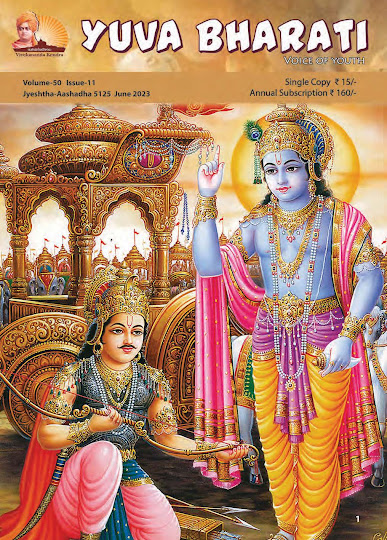
The release of the Movie “The Kerala Story” kicked up a controversy recently. The movie showing the darker sides of the proselytizing face of Islam is bound to raise many dissenting voices. This is not unexpected in a society where tyrants like Tipu Sultan are glorified. The movie centers around the alleged religious indoctrination in Kerala and how Hindu and Christian girls are being targeted by radical Islamic clerics. The film claims that these women were converted to Islam and later sent to countries like Yemen and Syria, “to fight for the cause of Islam”.

The liberals in Kerala which includes two major political parties who are opposed to this movie stating that it spreads hate and false information intended to defame Muslims and Kerala. One of their arguments in opposing the movie is that the movie peddles a very big number as the women who have been converted and sent to other countries to fight the religious war. They say that the number is far less and not in thousands as alleged in the Film. Even the liberals who are the campaign managers for the anti-India forces are not able to outrightly deny it. Let us assume that the numbers are less as argued by the liberals. Does it reduce the enormity of issue? The fact that these elements are having a free hand in a culturally rooted state like Kerala to hoodwink the women in the guise of Love, convert them to their religion for the sake of Marriage, brainwash them in the name of imparting religious teaching and then transport them to hostile territories which are not safe for even men, proves that these fundamentalist elements are having enough scope and support in our country to operate and carry out their designs. Whether the number is ten or ten thousand, it is something to worry about. And this is not something that is confined to Kerala alone. The borders of our cultural nation are breached and we hear the sad stories from every other state.

There is a question which the Hindu society has to ponder about. How a person who was brought up in a culture for twenty years, is made turn up against it within six months or one year? They even go to the extent of working against the country and killing their own brethren. Does this mean that the campaign by the fundamentalists is so powerful and compelling? We have to a soul searching here.  Anybody in his sane elements will reject these fundamentalist doctrines for their sheer absence of Logic and its ruthless intention to hurt others who do not subscribe to their point of view. Then what is that which lures them?  What can our society do to avert this? The absence of connect to their cultural roots and heritage is the main reason for this. We have to groom our kids to be proud of our culture. This is an uphill task, but a task of civilizational importance, because the narrative which is popular among our youth make them shun all the symbols of our culture. It starts from small things like the Bindi on the Fore head or our ethnic dresses, or the rituals one should follow, to the Indian way of life, our medicines, our art forms, our value systems. Our youth are ready to shun them for embracing the alternatives from the west. This situation must be reversed. Swami Vivekananda once said that, we must think hundred times before rejecting anything from our culture and should think thousand times before accepting anything from other cultures.

We as a society are duty bound to make them feel proud about their own heritage, because it is now or never.

                                                                                                                                 V.V.Balasubramanian

                                                                                                                                                        YB-ET


Monday, 1 May 2023

Progress to the destined role. : May 2023


Progress to the destined role.

Vishwa Guru

Many of us would have heard the terms Bharat, the Jagat Guru or India, the Vishwa Guru, uttered by our boudhik pramukhs in the Hindu organizations. These terms are being dismissed by our liberal society as cliched or mere rhetoric propagated by the right wing. But during the second week of April, we heard this term from totally unexpected quarters. It came from the deputy foreign minister of Ukraine Emine Dzhaparova. She while requesting India to intervene and play a greater role in bringing peace to the war-torn country of Her’s, also said that Ukraine views India as a Vishwaguru. For the first time in many years, we got to know about how other countries view us. She also said that our country has an important civilizational voice and Ukraine shares a common path with us as we promote values. This is in tune with the rising popularity of India as a Global Power.

We witnessed in recent times how our country managed to wriggle out of problems like the Pandemic and the problematic economic condition the world is currently in. While many around the world thought that India is one country which may find it difficult to handle such crisis because of its huge population, we proved to them wrong as we not only managed the crisis but also reached out with help to other countries. India’s image has improved globally through these endeavors, that too in spite of the farcical coverage by the biased western media. Our Prime Minister Sri Modi ji also chided the western media for this biased approach. The recent G20 presidency is another good opportunity for India to showcase her economic progress as well as the rich cultural heritage.

However, while we head the G20 summit and we are being hailed by foreign ministers and countries and even after helping the United states by supplying crucial medicines during the pandemic, when it comes to Indian students trying to study in foreign countries with the help of scholarships, many universities view our nation as a third world country and it lays down rules that the student who wishes to study in that particular university has to have taken up some leadership role apart from studies in order to qualify for the scholarship programs. It puts them in a spot where they have to prove their credentials which students from few other countries will not be needing to. This shows that we must not settle with the praise we are getting as there are developments and improvements which need to be done and it is high time, we take back the glory our country once had.

Students should be able to study whatever they want, wherever they want and that should happen because of the fact that India is really a vishwaguru and not because India is a third world country in the eyes of other countries’ education systems. The New Education policy which will be implemented from the 2023 - 2024 academic year could be the first step to that reform and the recent scrapping of chapters about Mughal invaders portrayed as emperors is a good step to denounce the false narrative and teach India’s future leaders, the correct history and history as it happened and not as how it was told to us through these false narratives. It would be great to see our country take its rightful place globally as it is high time we bounce back from the countless years of invasion and colonization. To do that we must take all the praise and recognition we are receiving and move forward using them as motivation rather than slowing down.

                                                                                                                                                                                                                                                                                                         V.V.Balasubramanian

                                                                                                                                    YB-ET

Saturday, 1 April 2023

Vasudaiva Kutumbakam… :April 2023


India has taken up the responsibility of presidentship for the G20 summit for the year 2023. This is a premier forum intended for International economic cooperation. It plays an important role in shaping the governance on all major international economic issues. Being the biggest democracy and home to 1.4 billion people India befits the role in more ways than one, though the responsibility comes to every one of the member countries by rotation. The logo for this year’s summit is Vasudaiva Kutumbakam, One earth, One family, One future. As one of the oldest surviving civilizations of the world and a country with a rich plurality, this message is not another jargon but one that comes from India’s vast civilizational experience. This message is also the one which is the need of the hour. We demonstrated this message through our action during Covid Pandemic crisis, with our Vaccine diplomacy. The Logo and the Theme together convey this much needed message in a powerful manner.  They represent the Indian Vedantic ideal of living in Harmony with the Nature and fellow beings.

While we gear ourselves to celebrate the humanity with measures that can sustain and foster happiness for all, we do hear some detestable voices in some parts of our country. In the last couple of months there is a rise in the voice against the migrant workers in Tamilnadu. This is not just against the ethos of our plural culture but also against the Constitution. Our constitution Guarantees safety to each and every citizen through its article 19 (1)(e) which says that every citizen of India has the right to reside and settle in any part of India. The hue and cry is not just against the people who are in the white collar job, but also against the poor workers who migrate to other parts of India for their survival. These protests completely hide the fact that there is very minimal workforce available in the state. The business community is forced to seek the workforce from other parts of the country. No one would prefer to employ a labour who is not conversant with the local language. But in spite of hardships faced in the working environment, the migrant workers quickly adapt to the new circumstances, learning the local language, and bridging the gap between them and their employer. The same vested interests who protest now will be mute when the issue of illegal immigrants is raised. For them an illegal immigrant, who is inimical to the sovereignty of our nation is more acceptable than their own countrymen. The abhorrent voices raised just in time when we gear ourselves up to deliver the Universal Brotherhood message to the world from a responsible position is not a mere coincidence. This only shows that the path ahead in our journey towards the ideal is full of challenges. The strength of falsehood lies in its power to propagate, while the strength of truth is inherent in its message. Satyam Eva Jayate.

                                                                                                                                                                                                                                                                                                         V.V.Balasubramanian.

                                                                                                                                  
                                                                                                                                   YB-ET

Wednesday, 1 March 2023

The Spirit of Holi…

Just like the Bhogi festival in Tamilnadu, people in other parts of our country celebrate Holi, a festival which symbolizes the victory of Good over Evil. People throughout India celebrate this colorful festival with great zeal and enthusiasm. As one of the oldest festivals, there are many interesting stories associated with the festival's origin as one moves across the different states from North to South and East to West. Holi is famous as Basant Utsav in rural India. Gulal, abeer and pichkaris are synonymous with the festival. Elaborate plans are made to throw colors at the near and dear ones. Everybody wants to be the first one to color the other. In the ensuing battle of colors, everybody is drowned not just in colors of gulal but also in love and mirth. People love to drench others and themselves in colored water. 
But amidst all these festivities we should not forget the real spirit of this festival, which is to destroy the evils within oneself. While taking the festival to the next generation along with its puranic references is important, this symbolism should also be told to them. It marks the end of winter and beginning of spring. It marks the beginning of blossoming and fertility. All our festivals are in one way or the other intended to purify us internally. The vratas, japas and other elaborate processes which we undergo in each and every festival are meant for this self unfoldment only. Many of our festivals are celebrated with great pomp and buoyancy with the society. However splendorous they are, they still are for our personal refinement. Likewise, Holika Dahan also should remind us of getting rid of our negative emotions like Ego, Selfishness, wickedness, Greed, Lust and excessive indulgence in materialistic pleasures. Tradition and Culture will have meaning and bear fruits when we remember and imbibe the spirit behind observing them. This will not only help us but will also ensure that the legacy is carried on without any generation loss.

                                                                                                                                   V.V.Balasubramanian
                                                                                                                                                           YB-ET

Wednesday, 1 February 2023

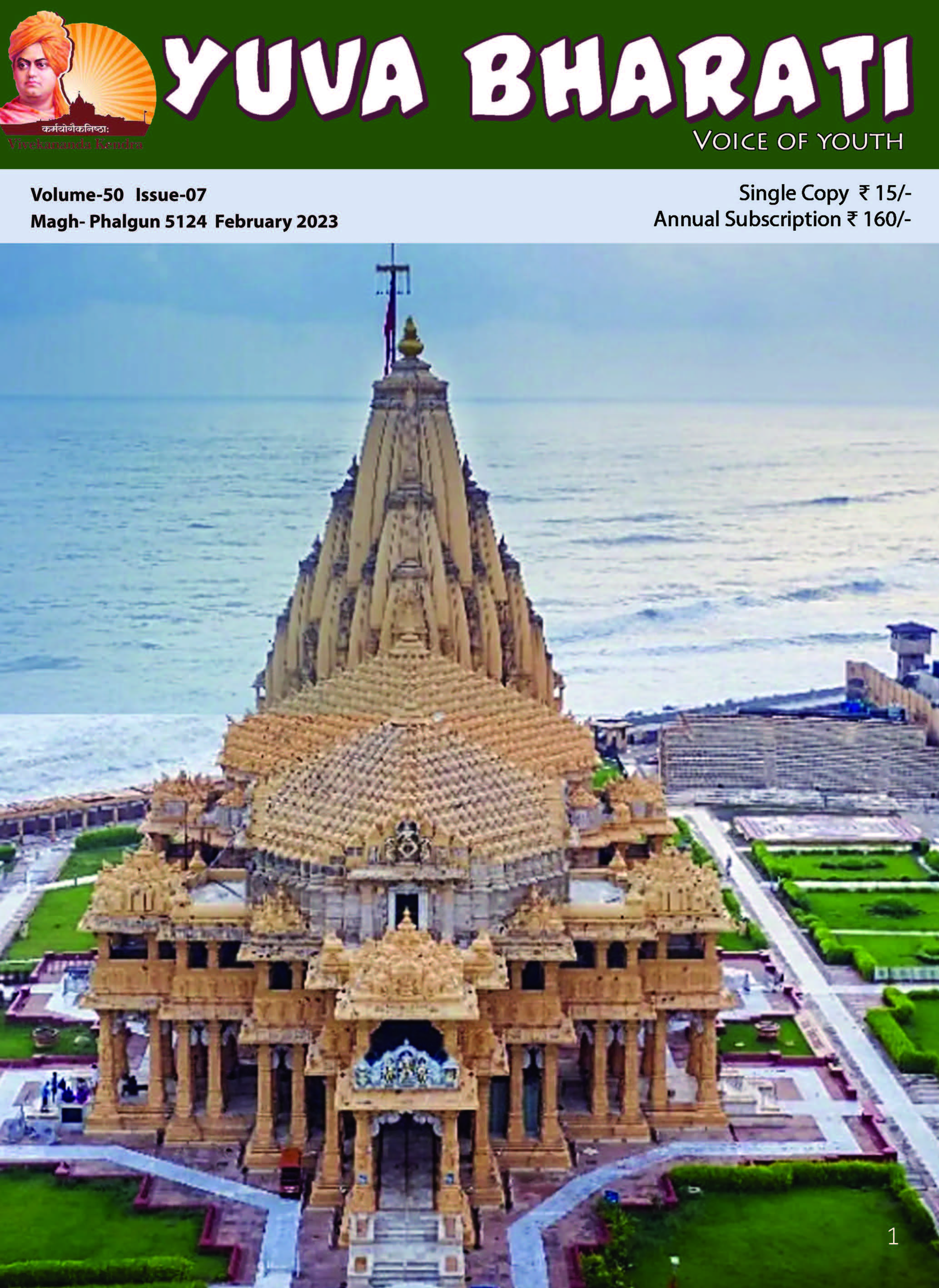
Somnath: The Spirit of Sanatana and Invincible Bharat : February 2023

 Though one can read about Somnath from various angles in this volume, howsoever what Somnath really stands for? Somnath temple represents the spirit of Sanatana Bharat and the invincible Bharat.

The wealth of Somnath attracted many greedy invaders. But it was not just wealth that motivated them. Actually, they were possessed by their exclusive religious ideology which taught them that their god was the only true god and others worshiped just idols. Thus their gods are false gods worth to be destroyed. They believed so much in their fallacy that they thought that if they break the 'idols', the 'idolators' will lose their faith. They did not know that Hindus worship Bhagawan in all the forms. We worship the One who is formless, who is ever present in all the forms and thus even if the forms are broken, the formless continues to exist everywhere, pervading everything. It is like the space in the pot. If the pot is broken, the space continues to exist. The eternal is always present.

Those who hold on to Eternal, cannot be wiped out at the destruction of the ethereal or apparent. This fact, the invaders just failed to understand and so they thought that if the temples were broken, these Hindus would be finished. They did not know that they were attacking India at a very superficial level. And thus the moment the invaders turned their back or as the Hindus gathered back their strength, again and again the grand temples arose. India thus holding on to the Eternal became invincible. The temple of Somnath symbolises the eternal and invincible Bharat.

Someone might ask that if India is Sanatana and invincible, why was there such degradation? Swami Vivekananda answers, 'There have been periods of decay and degradation. I do not attach much importance to them; we all know that. Such periods have been necessary. A mighty tree produces a beautiful ripe fruit. That fruit falls on the ground, it decays and rots, and out of that decay springs the root and the future tree, perhaps mightier than the first one. This period of decay through which we have passed was all the more necessary. Out of this decay is coming the India of the future; it is sprouting, its first leaves are already out; and a mighty, gigantic tree, the Urdhvamula, is here, already beginning to appear...'

Thus the intervening period of degradation was necessary for India to rise again more glorious to respond to the problems of humanity. To manifest the invincibility of India, to make her great again, to enable India to fulfill her ordained mission, Swami Vivekananda emphasized mainly on three things. Firstly, realizing that Dharma is the life center of India, we should practice Dharma vibrantly. Secondly, to unify the scattered spiritual forces of our nation focus on the life-giving common principles of our Dharma so that these are internalized. And thirdly, the need of the organized efforts to enable India to her ordained mission of helping humanity to evolve spiritually.

Dharma: The life center of India

Dharma is the life-center of India. Swami Vivekanand explains this, 'We have seen that our vigour, our strength, nay, our national life is in our Dharma. I am not going to discuss now whether it is right or not, whether it is correct or not, 'whether it is beneficial or not in the long run, to have this vitality in Dharma, but for good or evil it is there; you cannot get out of it, you have it now and for ever, and you have to stand by it, even if you have not the same faith that I have in our Dharma. You are bound by it, and if you give it up, you are smashed to pieces. That is the life of our race and that must be strengthened. You have withstood the shocks of centuries simply because you took great care of it, you sacrificed everything else for it. Your forefathers underwent everything boldly, even death itself, but preserved their Dharma. Temple after temple was broken down by the foreign conqueror, but no sooner had the wave passed than the spire of the temple rose up again. Some of these old temples of Southern India and those like Somnâth of Gujarat will teach you volumes of wisdom, will give you a keener insight into the history of the race than any amount of books. Mark how these temples bear the marks of a hundred attacks and a hundred regenerations, continually destroyed and continually springing up out of the ruins, rejuvenated and strong as ever! That is the national mind, that is the national life-current. Follow it and it leads to glory. Give it up and you die; death will be the only result, annihilation the only effect, the moment you step beyond that life-current. I do not mean to say that other things are not necessary. I do not mean to say that political or social improvements are not necessary, but what I mean is this, and I want you to bear it in mind, that they are secondary here and that Dharma is primary.' 


Uniting the Scattered Spiritual Forces

 How do we bring together the scattered strength in India? Swami Vivekananda said, 'The one common ground that we have is our sacred tradition, our Dharma. That is the only common ground, and upon that we shall have to build. In Europe, political ideas form the national unity. In Asia, Dharmik ideals form the national unity. The unity in Dharma, therefore, is absolutely necessary as the first condition of the future of India. There must be the recognition of one Dharma throughout the length and breadth of this land. What do I mean by one Dharma? Not in the sense of one religion as held among the Christians, or the Mohammedans, or the Buddhists. We know that our Dharma has certain common grounds, common to all our sects, however varying their conclusions may be, however different their claims may be. So there are certain common grounds; and within their limitation this Dharma of ours admits of a marvellous variation, an infinite amount of liberty to think and live our own lives. We all know that, at least those of us who have thought; and what we want is to bring out these lifegiving common principles of our Dharma, and let every man, woman, and child, throughout the length and breadth of this country, understand them, know them, and try to bring them out in their lives. This is the first step; and, therefore, it has to be taken.'

He further says, 'We see how in Asia, and especially in India, race difficulties, linguistic difficulties, social difficulties, national difficulties, all melt away before this unifying power of Dharma. We know that to the Indian mind there is nothing higher than Dharmik ideals, that this is the keynote of Indian life, and we can only work in the line of least resistance.'

In the speech 'Common bases of Hinduism' given by Swami Vivekananda we read about these life-giving principles. In Spite of the various sampradaya, the principles which are common are to us all are: God is everywhere, the existence is interconnected and interdependent; the manifested existence is without beginning and without end, it just disappears and appears again but is not destroyed; man is not body but Atman; man takes many births as per his karma; death is not an end to existence but just giving up the body to take another one; Atman is ever pure, eternal and immortal; the purpose of human life is to know Atman, our real Self; Dharma is not in believing but in being and becoming.


The need of organized efforts

Swami Vivekananda wanted us to organize to serve the needy and deprived persons in the society at the same time to rejuvenate our motherland. To attack on our temples, like Somnath, we could give a befitting reply only when we organized. The attacks on our civilization and Dharma continue even today though the nature of it is different. The attacks are more at thought level. Thus we need to organize to respond to those attacks. But the organizing ourself is not reactionary in nature. Even if the attacks are not there, we need to organize and work for raising the mankind to the higher consciousness, as only that can solve many problems facing humanity like, disintegration, degradation of nature, excessive individualism, crass selfishness and fanaticism that come out of exclusive religious ideologies. For all this we have to refocus on and internalise our life-giving principles. The thought that led to the formation of Vivekananda Kendra is based on these life giving principles. As Atman is our real Swaroopa, we must have conviction in our Atmic strength, which is eternal. Then while working for the society, whatever might be the problems we shall not crumble. The more we are rooted in our Atman, more we shall feel affinity, oneness with all. And thus working for Dharma, serving others without any apparent expectations like fame, money and power or subtle expectations like satisfaction of ego etc., will become spontaneous. In short, if we hold on to the Eternal, we become invincible; no change in situations, relationships, health status, behaviour of others, our own mental afflictions can deter us from the work for Dharma. 

In the book 'Spiritualising Life' Mananeeya Eknathji explains how a Kendra karyakarta should hold on to the unchangeable, the eternal in him so that he can face all the challenges. He says, 'To change the atmosphere, you must have an element of ‘Unchangeable’ in you. The gravitational pulls are so much that unless you are extraordinarily conscious of your own duty and your own role you will be undone in no time. If you have to change the atmosphere there must be some element of ‘unchangeable’ in you. Others change within two minutes, whereas you take five minutes. But you also change. You also don’t have resistance. The question is of only degrees. People fall a victim within 10 minutes and you fall a victim after 20 minutes. How the change could be brought about? So it means there must be at least a few persons who stand out and take upon themselves the responsibilities of bringing about a change in the society. Those who feel ordained to do it; those who feel called upon to do it; what should be their nature, what may be their quality? If in them there is something, some element that makes them different from others, and especially in the society where things are going wrong and only few people are there who can deliver the goods then more responsibilities lie upon them.

'Self-propelled workers do not know going back. Today in our country the situation is like this. Suppose a ton of wet fuel is put on the small fire, it will not be the fuel which will begin to burn. It will be the fire which will get extinguished. There may be fire. But then if the timber is wet, if the wet fuel is going to fall upon that small glow, fire would not be enough to set off the power of the whole lot of fuel. The timber will extinguish the fire. The fire will not burn them. This is the position. So you must have extra-ordinary inspiration in you. Then alone you can bring about a change. So when we say we are preparing a cadre of workers that means specialized cadre who are outstanding, and ordinarily whatever happens those laws are not applicable to them. There is something extra-ordinary in them. Then alone we can think of bringing about a change. We are out to build a team of self-propelled workers. Once they are set in motion, they go ahead. They do not know going back. They don’t have depressions. They don’t know ups and downs. Straight way they must go ahead. They are self-propelled. They never reach a point of exhaustion. This quality of making oneself self-propelled is the most important quality required of a worker if something great is to be achieved. Just as I said earlier that when we set out one should not say that well his capacity to go ahead is only for one year, two years. After two years, he will reach a breaking point. ‘It may be said of all others. But it should not be said of myself. I should not be belonging to that category. I should be self- propelled. Others may require a push.’

This is the spirit of Somnath that if we hold on to the unchangeable, to the eternal, if we hold on to the Atomic power within us, then we can face any challenging situation and we are not crumbled by the challenges of time or place. When we take the darshan of Somnath if we remember this, then as Swami Vivekananda says, 'the temple of Somnath will teach you the volumes of wisdom', we shall really have the insight in the secret of Sanatana and invincible Bharat.

 To conclude it in the words of Swami Vivekananda, 'Life is short, but the soul is immortal and eternal, and one thing being certain, death, let us therefore take up a great ideal and give up our whole life to it. Let this be our determination, and may He, the Lord, who "comes again and again for the salvation of His own people", to quote from our scriptures — may the great Krishna Bless us and lead us all to the fulfilment of our aims!' 


                                                                                                                          Nivedita Raghunath Bhide